
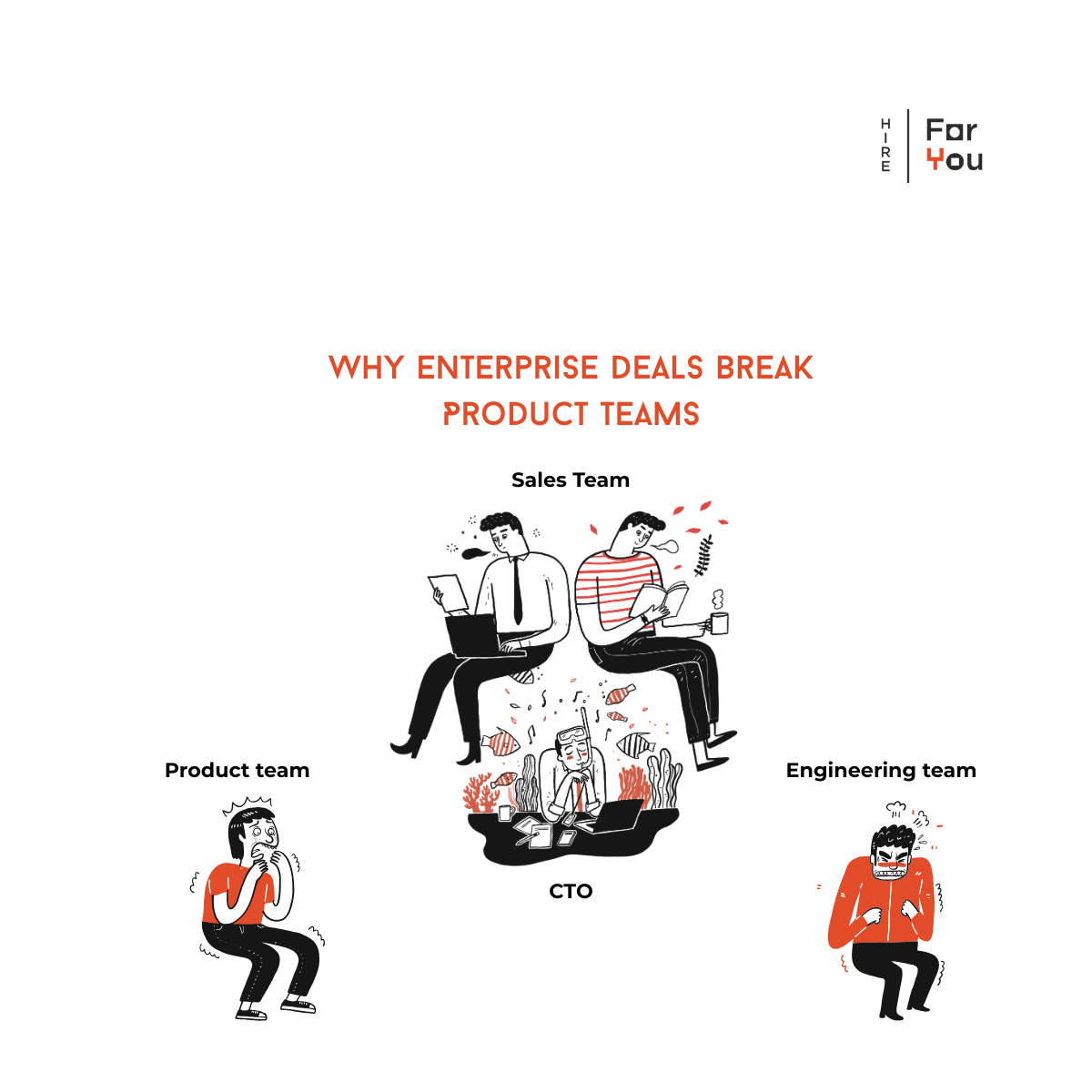
Why enterprise deals break product teams
When working with small and medium-sized businesses (SMBs), product development is typically driven by the needs of the majority. Each new feature improves the user experience for a significant portion of the customer base. The roadmap is shaped by product strategy.
Enterprise clients operate differently.
They rarely buy a product exactly as it exists today. Instead, they buy a product with exceptions: custom integrations, unique security requirements, dedicated approval workflows, specialized reporting, custom user roles, and business-specific processes.
Each request seems reasonable on its own. In many cases, saying "no" feels almost impossible, especially when the contract value comes with several extra zeros.
The sales team comes to Product and Engineering with a proposal:
"We can close this deal if we add just one feature."
Sounds simple enough.
For Product, it means a shift in priorities.
For Engineering, it means architectural changes, new dependencies, additional testing, maintenance obligations, and future technical debt.
Over time, the roadmap stops reflecting product strategy and starts reflecting promises made during enterprise negotiations.
The organization gradually begins optimizing for exceptions rather than scalability.
The hidden cost of exceptions
This almost always leads to growing technical debt.
According to McKinsey, 10% to 20% of the budget allocated to new technology initiatives is often spent dealing with technical debt, while the total value of accumulated technical debt can reach 20% to 40% of an organization's entire technology estate.
For product companies, this means that an increasing share of engineering resources is spent maintaining previous decisions rather than creating new value.
The most dangerous aspect of technical debt is that it rarely comes from poor engineering.
More often, it comes from business compromises that seemed perfectly reasonable at the time.
Every customization appears small.
Every integration looks justified.
Every new customer brings revenue.
But over time, these decisions compound and become a systemic problem.
When product and engineering start living in different realities
As enterprise business grows, another challenge emerges.
Product and Engineering begin looking at the same situation through different lenses.
Product teams focus on revenue, retention, customer commitments, and market competitiveness.
Engineering teams focus on system stability, maintainability, developer productivity, and long-term scalability.
As complexity increases, conflicts become more frequent.
The result is familiar to many scaling organizations:
- release delays;
- constantly changing priorities;
- growing technical debt;
- declining predictability.
This is where the well-known scaling paradox appears.
Headcount grows.
Budgets grow.
Revenue grows.
Yet delivery speed remains flat or even declines.
Why hiring more engineers often doesn't solve the problem
Many leaders believe the answer is straightforward.
Hire more people.
Open more positions.
Expand engineering teams.
However, years of DORA research by Google Cloud consistently show that high-performing engineering organizations are not defined by team size.
They are defined by their ability to deliver changes quickly, safely, and independently.
When system complexity grows faster than an organization's ability to manage it, increasing headcount rarely improves performance.
In fact, the required talent profile changes as well.
Early-stage companies can often succeed with highly skilled technical specialists.
Enterprise environments require something different.
They require engineers who can balance architectural and business constraints.
People who can operate under uncertainty.
People who understand customers, product strategy, and commercial realities.
This is one reason many companies believe the talent market has deteriorated.
In reality, the market has not changed nearly as much as the complexity of the problems organizations need people to solve.
The problem is often not headcount
Over the years, we've seen a recurring pattern at HireForYou.Pro.
A company believes it needs more engineers.
A deeper analysis often reveals that the issue is not capacity.
The organization is missing a different type of capability.
A technical leader capable of designing for future scale.
A Product Engineer who understands technology, customers, and business outcomes.
An Engineering Manager who can balance delivery speed with long-term sustainability.
The company continues hiring for its previous stage of growth while operating at an entirely different level of complexity.
As a result, headcount increases, but execution velocity remains unchanged.
The real lesson
Enterprise customers rarely break products.
They create a new level of organizational complexity.
The problem begins when companies stop calculating the long-term cost of every exception and start treating customization as a free source of growth.
Before signing the next major contract, leaders should ask more than:
"How much revenue will this deal generate?"
They should also ask:
"What people, systems, and architecture will we need to support this exception two years from now?"
Because in most scaling organizations, growth is not constrained by the number of employees.
It is constrained by the organization's ability to manage the complexity created by its own success.