
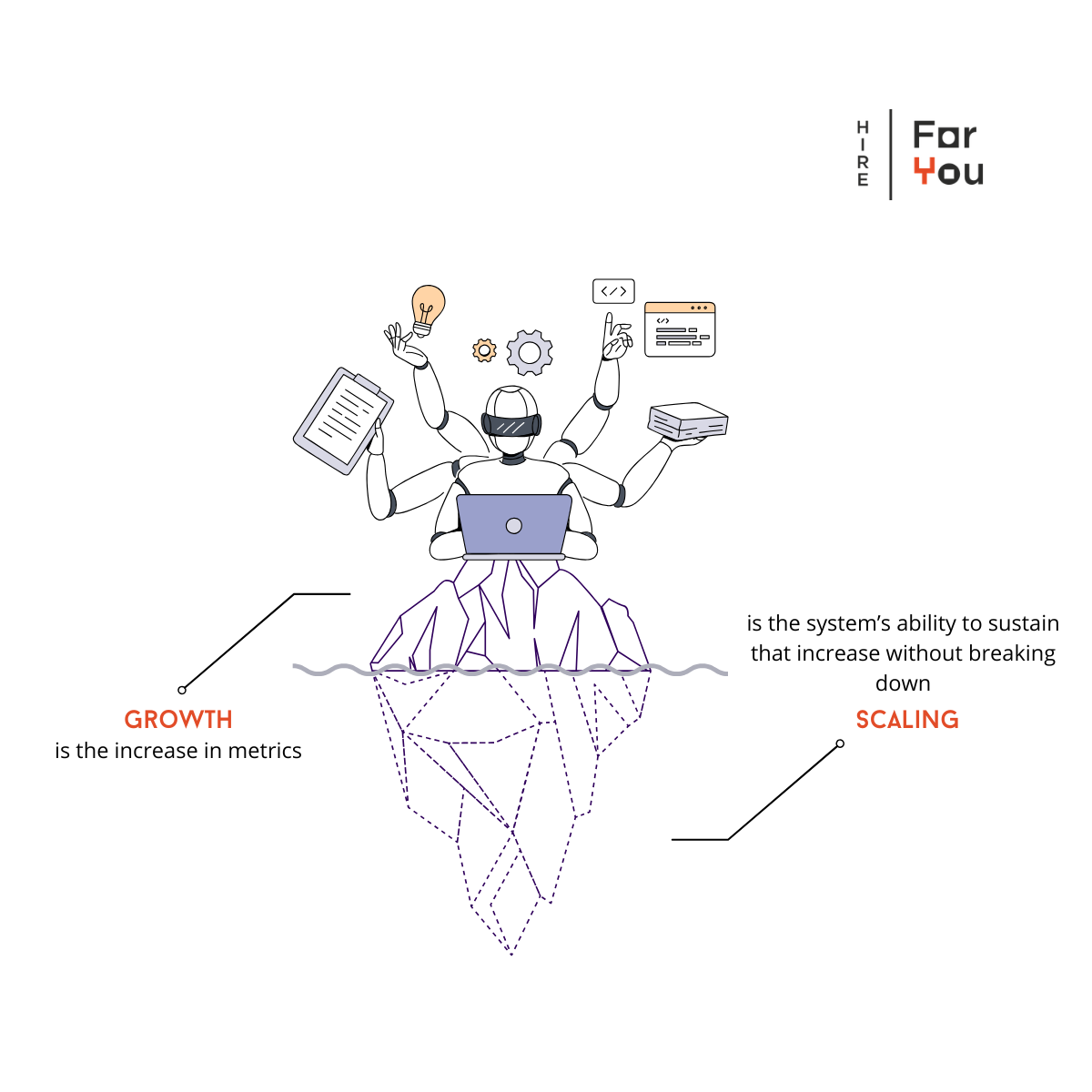
Scaling ≠ Growth: Why Companies Die
The biggest mistake startups make: they scale a system that eventually self-destructs
According to research by CB Insights, based on hundreds of startup post-mortems, companies rarely fail because of a single reason.
But the pattern repeats itself constantly:
- rapid growth,
- lack of coordination,
- loss of focus,
- broken processes,
- and only then - cash burn, layoffs, and shutdown.
One of the study’s most cited findings:
42% of startups failed because there was no real market need.
But there’s a less obvious problem.
Because behind every metric and every decision - there are people building the system.
From the outside it looks like growth. Inside - it looks like system overload
What are we seeing today?
Companies appear out of nowhere, launch new directions, secure investors, expand project portfolios, and scale teams from 20 to 80 people almost overnight.
Middle management appears.
Founders lose visibility and control.
Communication starts breaking under pressure.
And at this exact moment, businesses make a fatal mistake:
They continue scaling delivery without rebuilding the organization itself.
As a result:
- strong employees start firefighting instead of creating value;
- hiring accelerates, but onboarding quality declines;
- teams lose sight of shared goals;
- processes emerge too late;
- ownership becomes blurred;
- speed decreases despite growing headcount.
The company grows.
But efficiency does not.
This is false scaling.
The bigger the team, the more expensive the chaos
Many founders believe hiring alone can solve the problem.
Falling behind?
Simple - hire more people.
But without redesigning processes, every new employee increases system complexity.
In an interview with McKinsey & Company, TELUS CIO Hesham Fahmy highlighted a critical idea:
“Technology alone wouldn’t get us there. The transformation had to start with the team culture.”
Technology alone does not create scaling.
Scaling is built through:
- team culture,
- ownership,
- and the ability to make synchronized decisions across the organization.
TELUS transformed its IT function from a cost center into a value creation partner by changing how teams operated - not by endlessly increasing headcount.
This matters even more today, when companies are trying to scale simultaneously across:
- AI,
- product development,
- international expansion,
- and aggressive hiring.
If the organizational model stays the same, growth starts destroying the company from within.
The most dangerous stage of business is hypergrowth
Most companies prepare for market downturns.
Almost nobody prepares for the fact that rapid growth:
- increases conflict,
- creates bottlenecks,
- destroys transparency,
- and dramatically raises the cost of mistakes.
At an early stage, founders know everything.
At the scaling stage - that becomes impossible.
And if at that moment:
- there’s no alignment between teams,
- there’s no strong middle management,
- hiring becomes reactive and chaotic,
- processes exist only “inside people’s heads,”
- and culture itself doesn’t scale - the company starts losing control faster than revenue grows.
That’s why startups can still look successful just months before collapse.
Why strong engineers cannot save a weak system
One of the most underestimated scaling problems is overvaluing individual contributors.
Companies often think:
“If we hire strong senior engineers, everything will work.”
But strong specialists cannot compensate for:
- poor coordination,
- lack of ownership,
- conflicting priorities,
- broken communication,
- unclear strategy.
In fact, the stronger the specialists are, the faster they burn out inside a chaotic system.
A strong team without a strong system becomes an expensive group of heroes constantly patching the consequences of bad scaling decisions.
Scaling requires rebuilding, not acceleration
The most dangerous belief inside a growing company is:
“What got us here will get us further.”
It won’t.
Processes that worked for 15 people collapse at 70.
Founder-driven communication breaks across multiple products.
Implicit agreements stop working in distributed teams.
Every new stage of growth requires:
- a new level of management,
- a new communication structure,
- new hiring approaches,
- new accountability principles,
- and a new collaboration culture.
Scaling is not about “doing more.”
Scaling is rebuilding the system so it can survive more.
Companies don’t die because of lack of growth
They die when growth outpaces the organization’s ability to adapt.
That’s why:
- hiring without alignment creates a dead-end evolution path,
- hypergrowth without structure destroys delivery,
- and rapid expansion without rebuilding teams leads to collapse - even in a strong market.
Growth proves demand.
Scaling proves business maturity.
And the difference between them is often the difference between an IPO and a post-mortem.
HireForYou.Pro works with growing tech companies at the stage where simply “hiring more people” is no longer enough.
When businesses need to:
- redesign hiring for scaling,
- build coordination between teams,
- strengthen delivery,
- reduce the cost of organizational chaos,
- and create systems capable of sustaining growth instead of collapsing under it.
We don’t patch holes.